December iOS Device Performance Ranking: A19 Pro Narrowly Outperforms M3
Compared to the November rankings, the top two positions remain unchanged, the third and fourth places are swapped, the fifth place drops to sixth, and the sixth place rises to fifth. The remaining rankings remain the same.
A highlight of this ranking is that the iPhone 17 Pro Max’s A19 Pro chip achieved a slightly higher average score than the iPad Air 2025 (13-inch) with its M3 chip, while the iPhone 17 Pro, also equipped with the A19 Pro chip, closely followed.

It’s important to note that the current average benchmark scores for iOS devices are based on AnTuTu V10, not the latest AnTuTu V11.
To ensure the reasonableness and fairness of the benchmark rankings:
AnTuTu’s ranking scores are the average of all benchmark scores for that model in the current month, not the highest score. When comparing with your own phone of the same model, a fluctuation of around 100,000 points is normal.
Models with fewer than 1000 valid benchmark scores in a given month are not included in the monthly rankings. Devices not appearing on the list are likely due to insufficient valid benchmark scores. You can search for the specific phone model in the AnTuTu app to obtain relevant benchmark information.
The configurations appearing on the list represent the highest valid benchmark scores for that model. Therefore, the absence of some models’ highest configurations is likely due to insufficient valid benchmark scores.
Many factors, including phone temperature, usage patterns, and system version, can affect benchmark results.
Ranking data is only from China, collected from December 1st to December 31st, 2025.
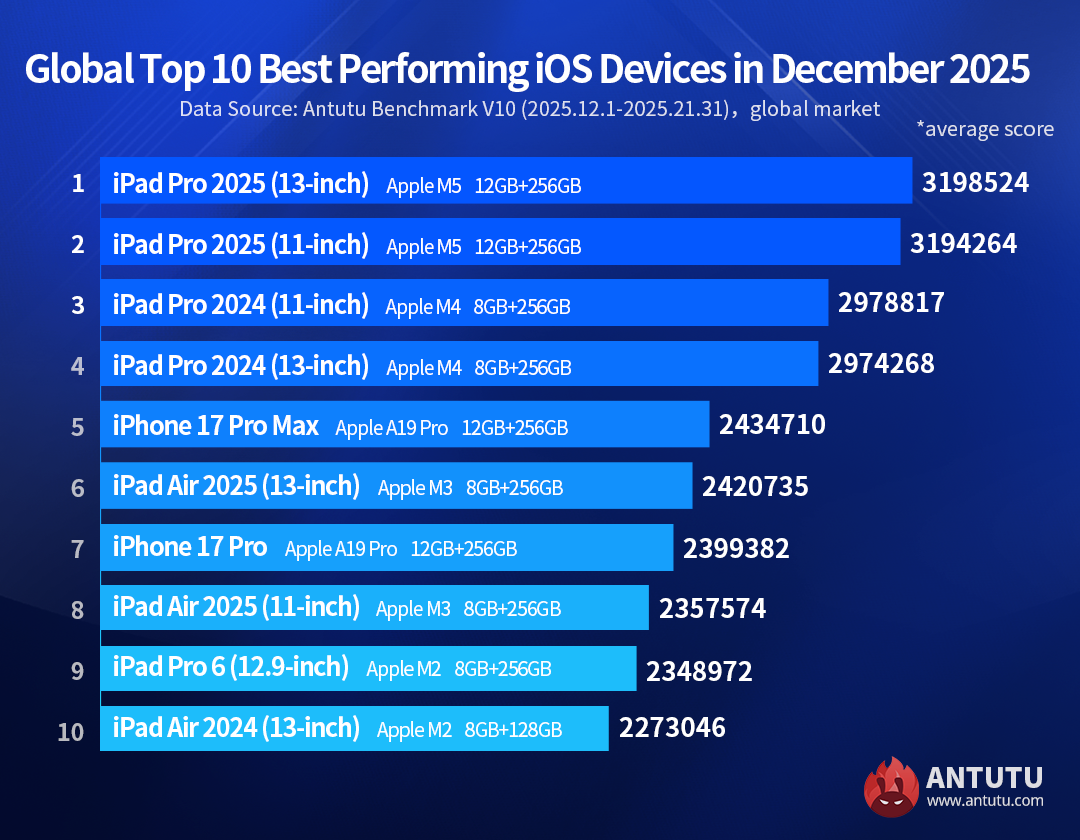
TOP 1: iPad Pro 2025 (13-inch) | 3,198,524
The iPad Pro 2025 (13-inch) features the third-generation 3nm M5 chip, integrating a 10-core CPU (4 performance cores + 6 efficiency cores) and a 10-core GPU. Multi-threaded performance is 15% faster than the M4, graphics processing is 30% faster, and peak AI computing performance is four times that of the M4. Unified memory bandwidth reaches 153GB/s, a 30% improvement over the previous generation. The 256GB/512GB versions come standard with 12GB of RAM, while the 1TB/2TB versions are upgraded to 16GB, meeting the multitasking needs of professional applications.
Its display uses dual-layer OLED Super Retina XDR technology, with a peak brightness of 1600 nits, supporting a 120Hz ProMotion adaptive refresh rate and P3 wide color gamut. Optional nano-textured glass reduces glare.
TOP 2: iPad Pro 2025 (11-inch) | 3,194,264
The 11-inch iPad Pro (M5 chip) also features Apple’s self-developed M5 chip. Whether it’s the 13-inch or 11-inch model, the processor specifications are virtually identical, so theoretically, the performance of the two tablets is the same. Undeniably, the larger screen size does help with passive heat dissipation, as the increased physical area allows for better heat dissipation from the chip. Of course, this is only one reason; many factors influence benchmark scores, such as individual chip differences, ambient temperature, and the initial temperature of the device.
TOP 3: iPad Pro 2024 (11-inch) | 2,978,817
The addition of Apple’s M4 chip enabled a significant performance leap for the 11-inch iPad Pro. As Apple’s first chip using a 3-nanometer process, the M4 integrates 28 billion transistors, featuring a 10-core CPU (4 performance cores + 6 efficiency cores) and a 10-core GPU, offering four times faster graphics processing speeds than its predecessor, the M2, and significantly improved energy efficiency. In terms of CPU, it employs an ultrawide architecture design, boasting single-core performance that surpasses most desktop processors. With multi-core collaboration, it can smoothly run professional-grade tasks such as 4K video editing and 3D modeling. The GPU supports dynamic caching and hardware-accelerated ray tracing, working in conjunction with the Liquid Retina XDR display’s 120Hz ProMotion adaptive refresh rate to achieve millisecond-level response times and cinematic visual effects.
The 11-inch iPad Pro features 20% more memory bandwidth, coupled with up to 16GB of unified memory, allowing for the simultaneous operation of multiple demanding applications without lag. Its Neural Engine performs 38 trillion operations per second, improving AI computing efficiency by 30%.